
06|Righteous Resources — Recommended Readings and Frameworks
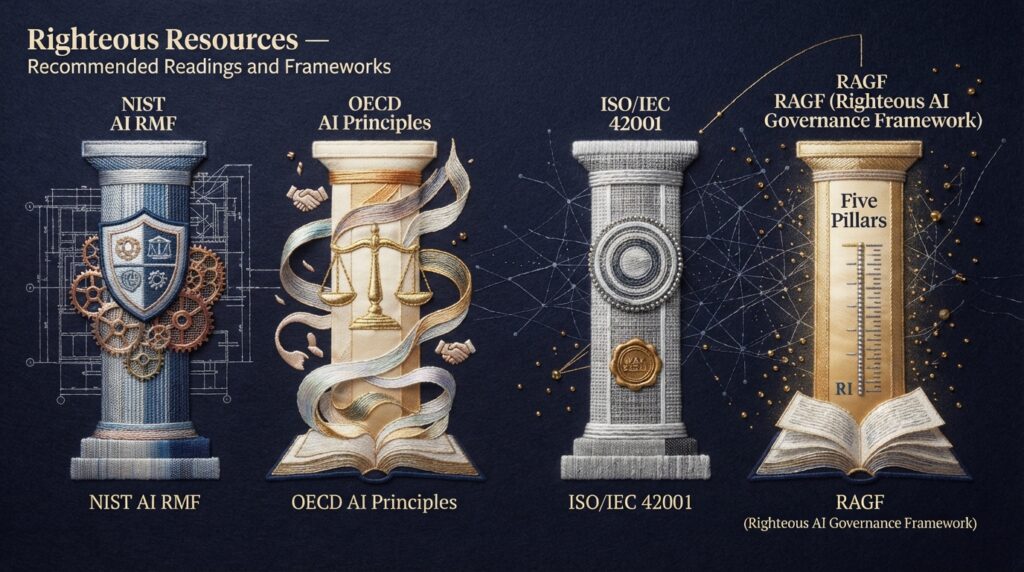
Curated resources for deeper exploration of AI righteousness.
Recommended AI Governance Frameworks and Resources
This table provides an overview of four key resources for understanding and implementing AI righteousness, including their focus, key features, and direct access links.
Table 1 — Recommended AI Governance Frameworks and Resources
| Framework / Resource | Focus | Key Feature | Access Link |
|---|---|---|---|
| NIST AI RMF | Risk Management | Govern · Map · Measure · Manage | www.nist.gov/itl/ai-risk-management-framework |
| OECD AI Principles | Values & Principles | Human rights, fairness, transparency, accountability | oecd.ai/en/ai-principles |
| ISO/IEC 42001 | Management System | Certifiable AI management system | www.iso.org/standard/81230.html |
| RAGF | Righteousness Governance | Five Pillars · Seven Layers · RI Measurement | www.wiserighteous.org/righteous-ai-governance-framework-ragf |
Framework Overviews
NIST AI RMF — Risk Management Framework
Published: January 2023 | Publisher: U.S. National Institute of Standards and Technology
The NIST AI Risk Management Framework (AI RMF 1.0) is a voluntary guidance document designed to help organizations manage risks associated with AI systems. It provides a structured approach to developing and deploying trustworthy AI by reducing security risks, avoiding bias, and protecting civil liberties. The framework is built around four interconnected functions — Govern, Map, Measure, and Manage — which enable organizations to identify, assess, and mitigate AI risks throughout the system lifecycle.
Why It Matters for AI Righteousness: NIST AI RMF provides the foundational “risk management” layer that every righteous AI governance framework builds upon. It answers the question: “How do we identify and reduce harm?” — a necessary first step toward righteousness.
OECD AI Principles
Adopted: May 2019 | Updated: May 2024 | Publisher: OECD
The OECD AI Principles are the first intergovernmental standard on AI, promoting innovative and trustworthy AI that respects human rights and democratic values. Updated in 2024 to address rapid technological advances, they provide a practical and flexible framework for AI governance. The principles cover inclusive growth, human rights and democratic values, transparency and explainability, robustness and security, and accountability.
Why It Matters for AI Righteousness: The OECD Principles articulate the values that righteous AI must embody — human rights, fairness, transparency, and accountability. They answer the question: “What principles should guide us?”
ISO/IEC 42001 — AI Management System
Published: December 2023 | Publisher: ISO/IEC
ISO/IEC 42001:2023 is the first international standard designed for AI management systems (AIMS). It specifies requirements for establishing, implementing, maintaining, and continually improving an AI management system within the context of an organization. The standard provides a certifiable framework to help organizations develop, deliver, or use AI systems responsibly while meeting applicable requirements and stakeholder expectations.
Why It Matters for AI Righteousness: ISO/IEC 42001 provides the management infrastructure that turns righteous principles into auditable, certifiable practice. It answers the question: “How do we build a system that ensures righteousness is consistently applied?”
Righteous AI Governance Framework (RAGF) — Full Document
Published: 2026 | Publisher: WiseRighteous Network
The Righteous AI Governance Framework (RAGF) is a comprehensive governance framework designed to integrate measurable righteousness into AI governance across the full AI lifecycle — from developers and providers to organizations, users, AI agents, and robots.
Table 2 — Core Structure of RAGF
| Component | Description |
|---|---|
| Five Pillars of AI Righteousness | Integrity · Justice · Stewardship · Wisdom · Beneficence |
| Seven‑Layer Governance Architecture | Foundation → Policy → Map → Measure → Manage → Assess → Sustain |
| RI Measurement System | Righteousness Index (RI) · Righteousness Growth Score (RGS) · Righteousness Decision Metric (RDM) · Righteousness Performance Score (RPS) |
Why It Matters for AI Righteousness: RAGF answers the question no other framework fully addresses: “How do we measure and grow righteousness over time?” It transforms righteousness from an abstract ideal into a measurable, auditable, and continuously improvable governance capability.
The RAGF Framework is the central resource of this issue. It is the framework that connects all the cases, principles, and governance approaches explored throughout Righteous Digest.
This table compares the four recommended frameworks across key dimensions — focus, key feature, and connection to AI righteousness.
Table 3 — Comparison of AI Governance Frameworks
| Framework | Focus | Key Feature | Righteousness Connection |
|---|---|---|---|
| NIST AI RMF | Risk Management | Govern · Map · Measure · Manage | Identifies and reduces harm |
| OECD AI Principles | Values & Principles | Human rights, fairness, transparency, accountability | Defines what righteous AI should embody |
| ISO/IEC 42001 | Management System | Certifiable AI management system | Provides auditable infrastructure |
| WRN RAGF | Righteousness Governance | Five Pillars · Seven Layers · RI Measurement | Measures and grows righteousness over time |
References
ISO/IEC. (2023). ISO/IEC 42001:2023 — Information technology — Artificial intelligence — Management system. International Organization for Standardization. https://www.iso.org/standard/81230.html
National Institute of Standards and Technology. (2023). Artificial Intelligence Risk Management Framework (AI RMF 1.0). U.S. Department of Commerce. https://www.nist.gov/itl/ai-risk-management-framework
OECD. (2024). OECD AI Principles. OECD Publishing. https://oecd.ai/en/ai-principles
WRN. (2026). Righteous AI Governance Framework (RAGF). WiseRighteous Network. https://www.wiserighteous.org/righteous-ai-governance-framework-ragf/