
04|Global Righteous AI Governance — Laws and Policies
A comparative overview of how major nations are governing AI with righteousness.
▸ EU AI Act — The world’s first comprehensive AI regulation
▸ U.S. AI Regulations — Executive orders, NIST frameworks, and state laws
▸ China’s AI Governance — Ethics guidelines and regulatory approaches
▸ Singapore’s AI Framework — Pragmatic and innovation-friendly governance
The Global Landscape: Four Approaches to Governing AI
Four major jurisdictions have emerged as the primary architects of AI governance, each reflecting distinct legal traditions and cultural values. The European Union has adopted the world’s first comprehensive AI regulation, operationalizing a risk-based regulatory model with ex-ante obligations and categorical prohibitions. The United States has taken a fundamentally different path, relying on a fragmented landscape of state AI laws alongside executive orders and voluntary frameworks, with no comprehensive federal AI law enacted as of 2026. China has pursued a governance model grounded in ethics guidelines and state-led oversight, releasing its Guidelines for Ethical Security of AI Applications 1.0 in May 2026. Singapore has positioned itself as a pragmatic and innovation-friendly jurisdiction, launching the world’s first Model AI Governance Framework for Agentic AI in January 2026.
These four approaches share a common concern with safety, transparency, and fairness. However, they differ in a critical respect: they are all fundamentally regulatory frameworks — concerned with what AI systems must not do, and how to prevent harm. They answer the question: “How do we constrain AI to prevent harm?”
None of them fully answers the question that righteousness demands: “How do we actively cultivate what is right?” Righteousness, unlike ethics or compliance, is not satisfied by the absence of violation. It requires the active pursuit of integrity, justice, stewardship, wisdom, and beneficence — a standard higher than the law’s minimum.
This table compares four major AI governance approaches — the EU AI Act, U.S. regulatory landscape, China’s governance model, and Singapore’s framework — across five dimensions: core approach, regulatory instrument, key innovation, enforcement mechanism, and righteousness alignment. The comparison reveals that while all four jurisdictions have developed sophisticated regulatory apparatuses, none fully operationalizes a proactive, value-driven standard of righteousness.
Table 4.1 — Comparison of Global AI Governance Approaches
| Dimension | EU AI Act | U.S. (2025–2026) | China (2026) | Singapore (2026) |
|---|---|---|---|---|
| Core Approach | Comprehensive, risk-based regulation | Sectoral statutes + state patchwork | Ethics-first, state-led governance | Pragmatic, innovation-friendly |
| Regulatory Instrument | Binding regulation (ex-ante) | Executive orders + state laws | Ethics guidelines + mandatory review | Voluntary frameworks + testing toolkit |
| Key Innovation | Risk-tiered obligations (unacceptable, high, limited, minimal) | State AI laws; AI Litigation Task Force | Nine ethics principles covering full AI lifecycle | World’s first Agentic AI governance framework |
| Enforcement Mechanism | Fines up to 7% global turnover | State enforcement + DOJ preemption challenges | Joint review + regional enforcement campaigns | AI Verify testing + accreditation scheme |
| Righteousness Alignment | Constrains harm; does not actively pursue good | Fragmented; enforcement uncertain | Ethics principles strong; implementation variable | Human accountability emphasized; voluntary adoption |
4.1 EU AI Act — The World’s First Comprehensive AI Regulation
The EU AI Act (Regulation (EU) 2024/1689) is the world’s first comprehensive, binding regulatory framework specifically designed to govern artificial intelligence. It distinguishes itself through a risk-based approach: rather than treating all AI applications the same, it categorizes AI systems based on their potential to harm health, safety, and fundamental rights.
This table details the EU AI Act’s four risk categories — Unacceptable, High, Limited, and Minimal — along with the specific obligations tied to each tier and representative examples of AI systems that fall into each category. It shows that obligations scale with risk: outright bans at the top, procedural requirements in the middle, and no specific obligations at the bottom.
Table 4.2 — EU AI Act: Four Risk Tiers, Obligations, and Examples
| Risk Tier | Description | Obligations | Examples |
|---|---|---|---|
| Unacceptable Risk | AI systems posing clear threats to safety, rights, or livelihoods | Banned outright | Social scoring, manipulative AI, real-time biometric identification |
| High Risk | AI used in sensitive areas with significant impact potential | Conformity assessment, technical documentation, human oversight, post-market monitoring | Credit scoring, hiring tools, medical diagnostics |
| Limited Risk | AI requiring user awareness | Transparency disclosure (Article 50) | Chatbots, emotion recognition, generative AI |
| Minimal Risk | Most AI systems with low-risk applications | No specific obligations | Spam filters, video games |
Source: GDPR Local, 2026; Article 99, EU AI Act
Prohibited AI practices — including harmful manipulation, social scoring by public authorities, and untargeted scraping for facial recognition databases — became effective February 2, 2025. Penalties for prohibited practices reach up to €35 million or 7% of global annual turnover, whichever is higher. High-risk systems face penalties up to €15 million or 3%, and limited-risk systems up to €7.5 million or 1%.
High-risk AI systems face the most demanding requirements: conformity assessments, technical documentation, EU database registration, human oversight mechanisms, and post-market monitoring. Transparency obligations under Article 50 for limited-risk systems are in full effect as of August 2, 2026, while high-risk conformity assessments have until December 2, 2027.
The Righteousness Gap
The EU AI Act is a landmark achievement in AI regulation. But it is a constraint framework — it defines what AI systems must not do, and sets procedural requirements for those deemed high-risk. It does not ask whether an AI system is actively pursuing integrity, justice, stewardship, wisdom, and beneficence. It asks only whether it has crossed a threshold of harm. Righteousness demands more.
4.2 U.S. AI Regulations — Executive Orders and the State Patchwork
The United States has taken a fundamentally different path. With no comprehensive federal AI law enacted, the U.S. regulatory landscape in 2026 is defined by a complex and evolving patchwork of state laws.
Federal Deregulation and Preemption Efforts
At the federal level, the Trump Administration has pursued a deregulatory approach. On January 20, 2025, President Trump revoked Biden’s Executive Order 14110 on AI safety. On December 11, 2025, he signed Executive Order 14365, titled “Ensuring a National Policy Framework for Artificial Intelligence,” which proposes to preempt state AI laws deemed inconsistent with a federal policy of “minimally burdensome” regulation.
The order directs the Attorney General to establish an AI Litigation Task Force with the primary responsibility of challenging state AI laws. As of 2026, the Task Force had not yet filed lawsuits, as the executive order contemplates a sequenced process in which the Department of Commerce first identifies specific state laws for referral.
State-Level Activity
States have moved aggressively to fill the regulatory void. As of 2026, legislators across the country have introduced over 2,182 AI-related bills, with more than 1,500 bills under consideration in statehouses in a single year.
Key state laws effective January 1, 2026, include:
California Transparency in Frontier AI Act (SB 53) — Requires “frontier developers” of large AI models to publish risk frameworks, report critical safety incidents, and implement whistleblower protections. Penalties up to $1 million per violation.
AI Training Data Transparency Act (AB 2013) — Mandates that generative AI developers publish information about training datasets.
Colorado’s AI Act — Comprehensive AI legislation taking effect June 30, 2026.
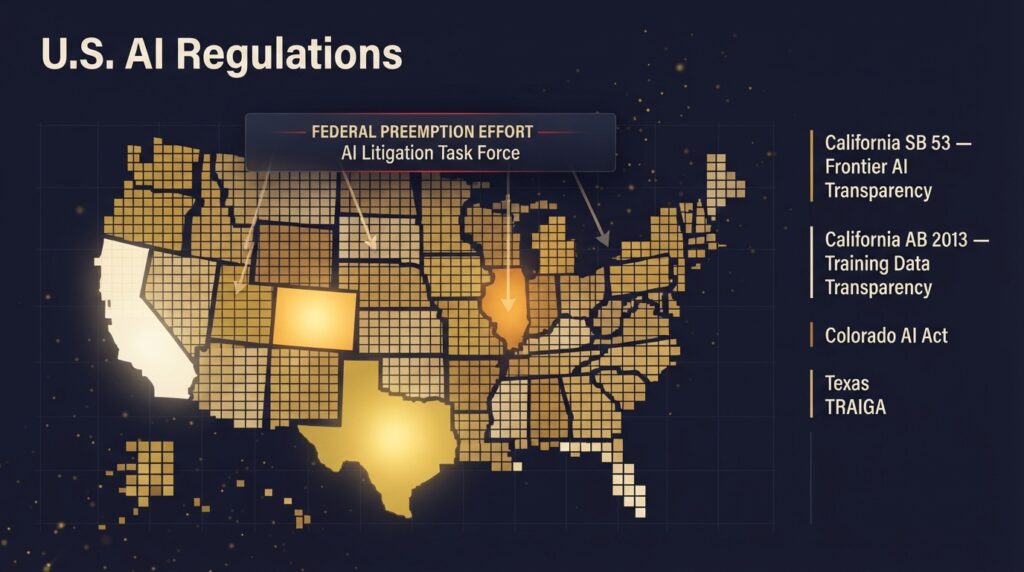
Figure 4.1 — The U.S. AI Regulatory Landscape: Federal vs. State
A conceptual diagram illustrating the tension between federal deregulation and state-level AI regulation in the United States. The diagram shows a fragmented map of 50 states with varying shades of regulatory activity, overlaid with a federal challenge mechanism (the AI Litigation Task Force) and key state laws labeled.
The Righteousness Gap
The U.S. approach is fragmented, contested, and largely reactive. State laws address specific harms — employment discrimination, data transparency, safety incidents — but no coherent framework articulates a proactive standard of righteousness. The federal government is actively challenging state regulations rather than building a unified framework. The result is a regulatory landscape defined by what is prohibited, not by what is actively pursued.
4.3 China’s AI Governance — Ethics Guidelines and Human Oversight
China has pursued a governance model grounded in ethics guidelines and state-led oversight. On May 19, 2026, China’s National Cybersecurity Standardization Technical Committee released the Guidelines for Ethical Security of AI Applications 1.0 — the first comprehensive guidance targeting ethics issues across the entire AI lifecycle.
Nine Ethics Principles
The Guidelines establish nine core principles:
Advance human well-being — AI should serve society and achieve sustainable development
Respect right to life — Uphold the principle of life above all
Fairness and impartiality — Eliminate algorithmic bias and discriminatory treatment
Risk rationality — Reasonably control risks at every stage
Transparency — Maintain openness about how AI systems operate
Privacy and security — Protect user data and personal information
Controllability and credibility — Ensure human control and trustworthiness
Agile governance — Adapt governance approaches as technology evolves
Inclusive benefits and shared gains — Ensure AI benefits are broadly distributed
The Guidelines also identify six major ethical risks: weakening of human oversight, disruption of public order, misinformation and knowledge distortion, algorithmic discrimination, infringement of individual rights, and damage to ecosystems.
Human Control and Oversight
A central feature of China’s approach is the emphasis on human control. The Guidelines call for ensuring that “the leadership over AI applications belongs to humans,” with mechanisms for human control, emergency response, and intervention established at key stages.
For high-risk scenarios — including financial, healthcare, and education applications — AI service providers must introduce compulsory human oversight. AI services should be equipped with functions of human intervention and be capable of handling emergencies.
Enforcement
Regulators in Shanghai, Zhejiang, and other provinces have launched a four-month AI compliance enforcement campaign, targeting training data safety, AI “poisoning,” using AI for misinformation, creating illegal content, and harming children.
This table maps China’s nine AI ethics principles against the Five Pillars of AI Righteousness, identifying areas of alignment and areas where China’s framework diverges from a righteousness-based approach. It shows strong alignment with Justice and Beneficence, moderate alignment with Integrity and Stewardship, and weaker alignment with Wisdom as a measurable governance capability.
Table 4.3 — China’s Nine AI Ethics Principles and the Five Pillars
| China’s Ethics Principle | Corresponding Righteousness Pillar | Alignment Strength |
|---|---|---|
| Advance human well-being | Beneficence | Strong |
| Respect right to life | Beneficence | Strong |
| Fairness and impartiality | Justice | Strong |
| Risk rationality | Wisdom | Moderate |
| Transparency | Integrity | Strong |
| Privacy and security | Stewardship | Moderate |
| Controllability and credibility | Stewardship / Integrity | Moderate |
| Agile governance | Wisdom | Moderate |
| Inclusive benefits and shared gains | Justice / Beneficence | Strong |
Source: IAPP, 2026; WiseRighteous Network, 2026
The Righteousness Gap
China’s Guidelines are the most explicit articulation of positive values among the four jurisdictions examined. The nine principles — particularly “advance human well-being,” “fairness and impartiality,” and “inclusive benefits and shared gains” — resonate with the Five Pillars of AI Righteousness. However, the Guidelines remain soft-law instruments, and their implementation depends on state-led enforcement campaigns rather than a measurable, auditable governance architecture.
4.4 Singapore’s AI Framework — Pragmatic and Innovation-Friendly Governance
Singapore has positioned itself as a pragmatic and innovation-friendly jurisdiction, focusing on voluntary frameworks, testing infrastructure, and human accountability rather than binding regulation.
Model AI Governance Framework for Agentic AI
In January 2026, Singapore launched the Model AI Governance Framework for Agentic AI at the World Economic Forum — the world’s first governance framework specifically designed for autonomous AI agents.
The framework provides guidance to organizations on how to deploy agents responsibly, recommending technical and non-technical measures to mitigate risks, while emphasizing that humans are ultimately accountable.
The framework is built on four pillars:
Assess and bound the risks upfront — Tiered risk levels guide agent autonomy
Enable meaningful human accountability — Human oversight at critical decision points
Implement technical controls and safeguards — Guardrails, monitoring, and audit trails
Enable user responsibility and oversight — Transparency and user control mechanisms
The framework was updated in May 2026 (Version 1.5) to include real-world case studies from over 60 organizations, including AWS, DBS, Google, Salesforce, and Tencent.
AI Tester Accreditation Programme (AI TAP)
Singapore has also launched AI TAP — Asia’s first accreditation programme for AI testing service firms. The programme accredits firms that can technically assess AI systems for safety, reliability, and governance risks, giving organizations greater confidence in third-party testing.
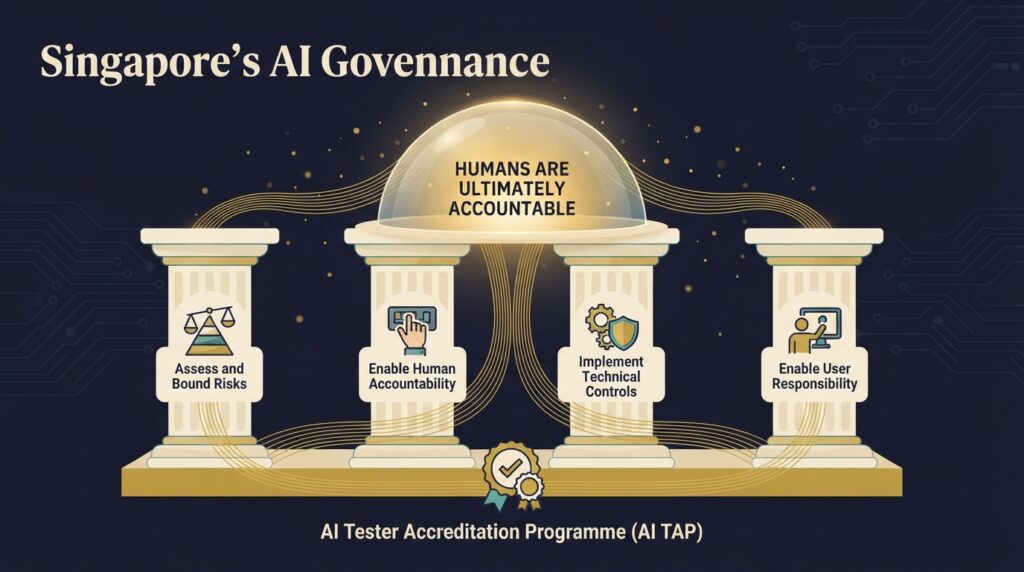
Figure 4.2 — Singapore’s Agentic AI Governance: Four Pillars and Human Accountability
A conceptual diagram illustrating Singapore’s Model AI Governance Framework for Agentic AI, showing the four pillars of the framework and the central principle of human accountability. The diagram also shows the AI Tester Accreditation Programme (AI TAP) as the assurance layer that supports the framework’s adoption.
The Righteousness Gap
Singapore’s approach is the most proactive among the four jurisdictions in terms of infrastructure-building — testing frameworks, accreditation schemes, and real-world case studies. But it remains voluntary. Organizations are encouraged, not required, to adopt the framework. And while the framework emphasizes human accountability, it does not provide measurable metrics for assessing whether an AI system is actively pursuing righteousness. It provides guidance for preventing harm, not a standard for cultivating good.
Summary: Four Approaches, One Missing Standard
All four jurisdictions have developed sophisticated regulatory apparatuses. The EU has binding law. The U.S. has a dynamic (if fragmented) state-level ecosystem. China has comprehensive ethics guidelines with strong state enforcement. Singapore has the most advanced testing and accreditation infrastructure.
But none of them asks the question that righteousness demands: “How do we measure and grow righteousness over time?” They ask: “How do we prevent harm?” That is ethics. Righteousness is higher.
Kids’ Version
Storytime: Four Towns, Four Rules
A gentle story for young children about four towns with different rules for their robots — and the question they all forgot to ask.
References
AI Verify Foundation. (2026, May 14). AI Tester Accreditation Programme (AI TAP). AI Verify Foundation. https://aiverifyfoundation.sg/tester-accreditation/
Baker Botts. (2026, January). U.S. artificial intelligence law update: Navigating the evolving state and federal regulatory landscape. Baker Botts. https://www.bakerbotts.com/thought-leadership/publications/2026/january/us-ai-law-update
Cloud Security Alliance. (2026, April 4). State AI laws take hold as federal preemption stalls. Cloud Security Alliance Labs. https://labs.cloudsecurityalliance.org/research/csa-research-note-us-ai-regulation-preemption-compliance-202/
European Parliament & Council of the European Union. (2024). Regulation (EU) 2024/1689 — Artificial Intelligence Act. Official Journal of the European Union. https://digital-strategy.ec.europa.eu/
GDPR Local. (2026, January 28). EU AI regulations overview: Risks, obligations, and enforcement. GDPR Local. https://gdprlocal.com/eu-ai-regulations/
Infocomm Media Development Authority. (2026, January 22). Singapore launches new Model AI Governance Framework for Agentic AI. IMDA. https://www.imda.gov.sg/resources/press-releases-factsheets-and-speeches/press-releases/2026/new-model-ai-governance-framework-for-agentic-ai
Infocomm Media Development Authority. (2026, May 20). Updated Model AI Governance Framework for Agentic AI. IMDA. https://www.imda.gov.sg/resources/press-releases-factsheets-and-speeches/updated-model-ai-governance-framework-for-agentic-ai
International Association of Privacy Professionals. (2026, May 27). Notes from the Asia-Pacific region: China issues new AI ethics guidelines, Hong Kong conducts compliance checks. IAPP. https://iapp.org/news/a/notes-from-the-asia-pacific-region-china-issues-new-ai-ethics-guidelines-hong-kong-conducts-compliance-checks
White & Case. (2026, January 15). State AI laws under federal scrutiny: Key takeaways from the executive order establishing federal AI policy framework. White & Case. https://www.whitecase.com/insight-alert/state-ai-laws-under-federal-scrutiny-key-takeaways-executive-order-establishing